CS grad student helps develop quantum-resistant security measures

Benjamin Franklin once compared the value of an ounce of prevention to that of a pound of cure. As quantum computing technology advances rapidly, researchers are investigating security issues that could emerge. One concern is the vulnerability of encryption methods used in current computer systems. NCSA Research Scientist Phuong Cao, Ph.D., told HPCwire, “The problem is urgent because practical quantum computers will break classical encryption in the next decade.”  Studying the post quantum cryptography adoption rate is critically important to the nation’s security. It is best showcased through collaboration between NCSA’s REU, Illinois’ ICSSP program, and NCSA’s security research team.

One Illinois graduate student, Jakub Sowa, is playing a role in developing quantum-resistant security measures for supercomputing applications. How he got to do so epitomizes another saying from Franklin: “Energy and persistence conquer all things.”

NCSA Research Scientist, Dr. Phuong Cao, and Jakub Sowa, while he was an undergraduate at the Grainger College of Engineering Siebel School of Computing and Data Science at the University of Illinois Urbana-Champaign, presented paper at September’s IEEE International Conference on Quantum Computing and Engineering in Montreal. Their findings proposed the design of a novel Post-Quantum Cryptography (PQC) network instrument housed at NCSA and the U. of I. and integrated as a part of the international  FABRIC testbed; showcased the latest results on PQC adoption rate across a wide spectrum of network protocols; described the current state of PQC implementation in key scientific applications like OpenSSH and SciTokens; highlighted the challenges of being quantum-resistant; and emphasized discussion of potential novel attacks.

Sowa is now a first-year graduate student at Illinois. Born in Poland, he grew up in the southwestern suburbs of Chicago and says, “I got into computing in high school, where I had the great privilege of taking my first computer science classes and was introduced to quantum computers. I really liked how many problems could be solved computationally, and it was a great joy to craft those solutions myself. I had somewhat of a dream from childhood to be a great scientist, bringing about huge discoveries after watching a documentary on Einstein. At the time, and even now, quantum computers were at the forefront of computing, and I got excited about the prospect of working on something so revolutionary.”

Jakob Sowa
Jakob Sowa

Sowa’s initial ambition to attend the University of Chicago was sidelined by the COVID-19 pandemic, his status as an international student, and the financial challenges faced by his parents. “I knew it was on me to figure out a way to fund my education,” Sowa says. He spent a year at Moraine Valley Community College in Palos Hills, Illinois, where he “realized that Illinois offered bigger opportunities in computer science. I knew it was highly competitive, and that was reinforced at one point by my community college professor when, in response to my question about my chances of being accepted as a transfer, they said they were really low, and it was unlikely. I always wanted to accomplish great things, and I knew that was only possible if I was surrounded by the best who could inspire and teach me to learn more. I knew I had to go here then, especially with how close it was to my friends at home in Chicago. Luckily, I was able to prove that professor wrong and get accepted.”

Sowa seized the opportunities available to him. He says “I got interested in security issues primarily through the  Illinois Cyber Security Scholars Program scholarship program here on campus. We are a group of students who receive possibly the most generous scholarship on campus (which helped me with financial struggles), who essentially pledge to focus on cybersecurity here and work in the government after graduation in the interest of protecting people in the country. This gave me an additional motivation for all my efforts, to ensure people have reliable and safe access to critical services (which relies on a secure internet) like electricity.”

Sowa joined the Students Pushing INnovation (SPIN) Internship Program (SPIN) program at NCSA in the summer of 2023. He participates in the CyberCorps: Scholarship for Service program, which is NSF-funded, and will work after graduation for the U.S. government in a position related to cybersecurity.

“I found myself back in the realm of quantum computing somehow when Dr. Phuong Cao introduced post-quantum cryptography to me, almost entirely by chance. I had taken a class on cryptography here the year before, which is why I felt up to learning about the quantum version, but there weren’t any quantum computing classes here then, so I went in totally blind but very eager to learn.”

Dr. Cao, as a TrustedCI Fellow, has been working with the  NSF Cybersecurity Center of Excellence, to bring cutting edge techniques such as formal verification, securing Jupyter Notebooks, high-fidelity cyber attacks analyses and visualization, security testbed for preempting ransomware, and quantum computing to the field of secure high performance computing. Most recently, he is the principal investigator in a $200,000 award from the Office of Advanced Cyberinfrastructure, NSF, for a plan on “Quantum-Resistant Cryptography in Supercomputing Scientific Applications.” The Co-Principal Investigators are  Anita Nikolich, Director of Research and Technology Innovation and Research Scientist, School of Information Sciences, and NCSA research scientist; Ravishankar Iyer  ECE George and Ann Fisher Distinguished Professor of Engineering and NCSA researcher, and Santiago Nunez-Corrales NCSA researcher and faculty affiliate at the Informatics Department of the School of Information Sciences and The Illinois Grainger Engineering IQUIST center.

Phuong Cao presenting on security attacks targeting HPC at 2023 ACM/IEEE Supercomputing Conference.
Dr. Phuong Cao presenting on security attacks targeting HPC at 2023 ACM/IEEE Supercomputing Conference.

Through NCSA’s SPIN program, Jakub has learned to deliver well-received public talks through NCSA SPIN program at the Illinois Undergraduate Research Symposium, using it as practice opportunities for the IEEE QCE conference. Dr. Cao says of Sowa, “Jakub is a quick learner and a talented student in applied cryptography, security data curation, and analyses. Jakub’s talent is evidenced by his quick grasp of complex cryptography concepts such as asymmetric encryptions, Diffie-Hellman Key Exchange, and lattice-based cryptography, which is very challenging even for senior graduate students to understand. Jakub, with his training at the U. of I. security lab, comfortably illustrated such concepts and their relations to Post Quantum Cryptography in the first two weeks of his SPIN internship. In addition, Jakub was able to apply those concepts to real-world security data curated at NCSA across a wide spectrum of applications across all seven layers of the OSI Network stack to analyze the adoption rate of such protocols. Jakub also worked diligently to document his efforts, with a high level of clarity in a shared LaTeX document from day one, so the materials for the manuscript are readily available for edits and reviews.”

Dr. Cao, named an outstanding 2023-24 NCSA mentor, continues to mentor Sowa, who says  “I did the initial research work in the summer of 2023, before my senior year as an undergrad. The rest of the paper we completed in the last month of my senior year, earlier this year in the spring. Between those two timeframes, we had a lot of people helping with various parts of the research.” Following this success, Jakub continues at Illinois as a Master’s student and will continue to kickstart the research in Post Quantum Cryptography for interested students in the Undergraduate Research in Scientific Advancement program with Dr. Phuong Cao.


Grainger Engineering Affiliations

Ravishankar Iyer is an Illinois Grainger Engineering professor of electrical and computer engineering and is affiliated with department of electrical and computer engineering, NCSA, Coordinated Science Laboratory, Carle Illinois College of Medicine, and the Carl R. Woese Institute for Genomic Biology. Ravishankar Iyer is the George and Ann Fisher Distinguished Professor of Engineering.

SPIN Offers Real-World Applications to Students

The college experience can be a bit overwhelming with so many majors to choose from and fields to explore. Students frequently look for internships that offer real-world experiences. The Students Pushing INnovation (SPIN) at the National Center for Supercomputing Applications (NCSA) lets undergraduates get involved, be valued as key team members and work with researchers on projects with wide-ranging applications.

SPIN was launched in 2012 and gives undergraduate students a chance to work with NCSA staff and faculty affiliates on research and development projects in supercomputing, data analytics, visualization and more.

“Students can take the lead and make meaningful contributions on projects, give voice to their ideas and collaborate with researchers,” said Olena Kindratenko, Senior Research Coordinator at NCSA, who leads SPIN. She and a cadre of four student co-chairs helped organize this year’s successful 2nd Annual NCSA Student Research Conference, which attracted over 125 people from campus and industry. Read full article here.


Congratulations to Bach Hoang, SPIN intern

Congratulations to Bach Haong, SPIN inter, for being invited to present at the USENIX’24 Security Symposium, one of the top security conferences. Bach showcased his collaborative research with Dr. Phuong Cao and Jakub Sowa, SPIN intern, presenting two posters titled “Bringing Verification-Aware Languages to Formal Verification of Federated Authentication Protocols” and “Post-Quantum Cryptography (PQC) Network Instrument: Measuring PQC Adoption Rates and Identifying Migration Pathways”.

Congratulations to Jakub Sowa, SPIN interns

Congratulations to Jakub Sowa and Bach Hoang, SPIN interns, who authored the paper titled “Post-Quantum Cryptography (PQC) Network Instrument: Measuring PQC Adoption Rates and Identifying Migration Pathways”, with Jakub as the first author and Bach as the second author. The team was mentored by Dr. Phuong Cao and presented it at September’s IEEE International Conference on Quantum Computing and Engineering in Montreal. Full story is here.”

NCSA Awards Fiddler Innovation Fellowships to 10 Illinois Students

The National Center for Supercomputing Applications recognized 10 University of Illinois Urbana-Champaign students for their outstanding accomplishments in various fields of academic research. 
The group received Fiddler Innovation Fellowship awards, which are part of a $2 million endowment from Jerry Fiddler and Melissa Alden to UIUC in support of student and faculty interdisciplinary research initiatives through the Illinois Emerging Digital Research and Education in Arts Media (eDream) Institute at NCSA. The breadth of the student work included contributing to cutting-edge projects developing a campus chatbot, advising targeted humanitarian assistance for Syrian refugees with a machine-learning geospatial approach and significantly cutting down traditional analysis costs and helping to measure soil health and carbon credits.

The awards affirm the outstanding achievements and interdisciplinary contributions to NCSA student programs Students Pushing Innovation (SPIN) and Design for America during the 2022-23 academic year.

/*! elementor-pro – v3.16.0 – 20-09-2023 */
@charset “UTF-8″;.entry-content blockquote.elementor-blockquote:not(.alignright):not(.alignleft),.entry-summary blockquote.elementor-blockquote{margin-right:0;margin-left:0}.elementor-widget-blockquote blockquote{margin:0;padding:0;outline:0;font-size:100%;vertical-align:baseline;background:transparent;quotes:none;border:0;font-style:normal;color:#3f444b}.elementor-widget-blockquote blockquote .e-q-footer:after,.elementor-widget-blockquote blockquote .e-q-footer:before,.elementor-widget-blockquote blockquote:after,.elementor-widget-blockquote blockquote:before,.elementor-widget-blockquote blockquote cite:after,.elementor-widget-blockquote blockquote cite:before{content:none}.elementor-blockquote{transition:.3s}.elementor-blockquote__author,.elementor-blockquote__content{margin-bottom:0;font-style:normal}.elementor-blockquote__author{font-weight:700}.elementor-blockquote .e-q-footer{margin-top:12px;display:flex;justify-content:space-between}.elementor-blockquote__tweet-button{display:flex;transition:.3s;color:#1da1f2;align-self:flex-end;line-height:1;position:relative;width:-moz-max-content;width:max-content}.elementor-blockquote__tweet-button:hover{color:#0967a0}.elementor-blockquote__tweet-button span{font-weight:600}.elementor-blockquote__tweet-button i,.elementor-blockquote__tweet-button span{vertical-align:middle}.elementor-blockquote__tweet-button i+span,.elementor-blockquote__tweet-button svg+span{margin-left:.5em}.elementor-blockquote__tweet-button svg{fill:#1da1f2;height:1em;width:1em}.elementor-blockquote__tweet-label{white-space:pre-wrap}.elementor-blockquote–button-skin-bubble .elementor-blockquote__tweet-button,.elementor-blockquote–button-skin-classic .elementor-blockquote__tweet-button{padding:.7em 1.2em;border-radius:100em;background-color:#1da1f2;color:#fff;font-size:15px}.elementor-blockquote–button-skin-bubble .elementor-blockquote__tweet-button:hover,.elementor-blockquote–button-skin-classic .elementor-blockquote__tweet-button:hover{background-color:#0967a0;color:#fff}.elementor-blockquote–button-skin-bubble .elementor-blockquote__tweet-button:hover:before,.elementor-blockquote–button-skin-classic .elementor-blockquote__tweet-button:hover:before{border-right-color:#0967a0}.elementor-blockquote–button-skin-bubble .elementor-blockquote__tweet-button svg,.elementor-blockquote–button-skin-classic .elementor-blockquote__tweet-button svg{fill:#fff;height:1em;width:1em}.elementor-blockquote–button-skin-bubble.elementor-blockquote–button-view-icon .elementor-blockquote__tweet-button,.elementor-blockquote–button-skin-classic.elementor-blockquote–button-view-icon .elementor-blockquote__tweet-button{padding:0;width:2em;height:2em}.elementor-blockquote–button-skin-bubble.elementor-blockquote–button-view-icon .elementor-blockquote__tweet-button i,.elementor-blockquote–button-skin-classic.elementor-blockquote–button-view-icon .elementor-blockquote__tweet-button i{position:absolute;left:50%;top:50%;transform:translate(-50%,-50%)}.elementor-blockquote–button-skin-bubble .elementor-blockquote__tweet-button:before{content:””;border:.5em solid transparent;border-right-color:#1da1f2;position:absolute;left:-.8em;top:50%;transform:translateY(-50%) scaleY(.65);transition:.3s}.elementor-blockquote–button-skin-bubble.elementor-blockquote–align-left .elementor-blockquote__tweet-button:before{right:auto;left:-.8em;border-right-color:#1da1f2;border-left-color:transparent}.elementor-blockquote–button-skin-bubble.elementor-blockquote–align-left .elementor-blockquote__tweet-button:hover:before{border-right-color:#0967a0}.elementor-blockquote–button-skin-bubble.elementor-blockquote–align-right .elementor-blockquote__tweet-button:before{left:auto;right:-.8em;border-right-color:transparent;border-left-color:#1da1f2}.elementor-blockquote–button-skin-bubble.elementor-blockquote–align-right .elementor-blockquote__tweet-button:hover:before{border-left-color:#0967a0}.elementor-blockquote–skin-boxed .elementor-blockquote{background-color:#f9fafa;padding:30px}.elementor-blockquote–skin-border .elementor-blockquote{border-color:#f9fafa;border-left:7px #f9fafa;border-style:solid;padding-left:20px}.elementor-blockquote–skin-quotation .elementor-blockquote:before{content:”“”;font-size:100px;color:#f9fafa;font-family:Times New Roman,Times,serif;font-weight:900;line-height:1;display:block;height:.6em}.elementor-blockquote–skin-quotation .elementor-blockquote__content{margin-top:15px}.elementor-blockquote–align-left .elementor-blockquote__content{text-align:left}.elementor-blockquote–align-left .elementor-blockquote .e-q-footer{flex-direction:row}.elementor-blockquote–align-right .elementor-blockquote__content{text-align:right}.elementor-blockquote–align-right .elementor-blockquote .e-q-footer{flex-direction:row-reverse}.elementor-blockquote–align-center .elementor-blockquote{text-align:center}.elementor-blockquote–align-center .elementor-blockquote .e-q-footer,.elementor-blockquote–align-center .elementor-blockquote__author{display:block}.elementor-blockquote–align-center .elementor-blockquote__tweet-button{margin-right:auto;margin-left:auto}

Our students have consistently tackled many challenging issues, providing innovative solutions. They were willing to explore novel ideas, revisit and revise their approaches, and try again. Along the way, they not only impressed but also inspired their team members and mentors. The interdisciplinary contributions made by these students will serve as a foundation for the next cohort of students, propelling these advancements to new heights. We are delighted to help support these efforts through Fiddler Innovation Student Fellowships.

Olena Kindratenko, NCSA Senior Research Coordinator

Tweet

Fellowship awardee Kastan Day joined NCSA’s Center for Artificial Intelligence Innovation in the spring of 2023 and became the leading developer in training an AI model to function as an academic teaching assistant. His contributions resulted in a production-quality chatbot platform that can be rapidly trained to serve as a teaching assistant or an intelligent, knowledgeable assistant on a specific topic.

The platform is currently in use in select UIUC Electrical and Computer Engineering courses as well as a technical documentation assistant for NCSA’s Delta supercomputing system, with additional uses being developed across campus.

SPIN intern Pooja Tetali was recognized with a Fiddler Innovation Fellowship for her work on “A Machine Learning and Geospatial Approach to Targeting Humanitarian Assistance Among Syrian Refugees in Lebanon,” playing a pivotal role in processing the data and reviewing and testing the coding for the machine learning and geospatial analysis.

The impact of the research extended far beyond the classroom as findings from the project contributed to a working paper presented at the prestigious Economic Research Forum in Egypt, the foremost research network for economists in the Middle East, and were shared with the United Nations High Commissioner for Refugees. Tetali and her team’s work puts forth specific recommendations for a globally coordinated approach to accelerate the development of new frontier strategies in data science, which aim to enhance the targeting and distribution of humanitarian assistance amidst the challenges posed by increasing displacement and limited funding.

Chenhui Zhang was awarded the Fiddler Innovation Fellowship for the second year in a row, this time for his work on a new SPIN project, “Cross-scale Sensing and Deep Learning for Sustainable Agriculture.” Zhang aims to map important agroecosystem variables like crop nitrogen in a scalable way by synthesizing ground measurements, airborne hyperspectral images and satellite images.

Now a doctoral student at the Massachusetts Institute of Technology, Zhang harnessed machine-learning algorithms for three pivotal agroecosystem variables crucial to agricultural resilience and environmental sustainability.

“I’m very grateful for the opportunities and resources provided by NCSA and my mentors, Dr. Kaiyu Guan and Dr. Sheng Wang, for undergraduate students to explore a variety of interdisciplinary research topics,” Zhang said. “These explorations provided an important foundation for my Ph.D. research topics and are crucial for my current interests in AI and geospatial science. I would also like to thank Mr. Fiddler for graciously providing us with this opportunity to be recognized for our work, which motivated me to continue my exploration of my research.”

/*! elementor – v3.17.0 – 25-10-2023 */
.elementor-heading-title{padding:0;margin:0;line-height:1}.elementor-widget-heading .elementor-heading-title[class*=elementor-size-]>a{color:inherit;font-size:inherit;line-height:inherit}.elementor-widget-heading .elementor-heading-title.elementor-size-small{font-size:15px}.elementor-widget-heading .elementor-heading-title.elementor-size-medium{font-size:19px}.elementor-widget-heading .elementor-heading-title.elementor-size-large{font-size:29px}.elementor-widget-heading .elementor-heading-title.elementor-size-xl{font-size:39px}.elementor-widget-heading .elementor-heading-title.elementor-size-xxl{font-size:59px}

2023 Fiddler Innovation Fellowship Awardees

  • Pooja Tetali, SPIN
  • Chenhui Zhang, SPIN
  • Xiaojun Jia, SPIN
  • Zhiju Lu, SPIN
  • Evan Rafol, Design for America
  • Sara Kiel, Design for America
  • Claudia Robles, Design for America
  • Kaitlin Skurnak, Design for America
  • Kastan Day, NCSA Graduate student
  • Colter Wehmeier, Doctorate student in Art and Cultural Informatics at the School of Information Sciences

Undergraduate Researchers in Action

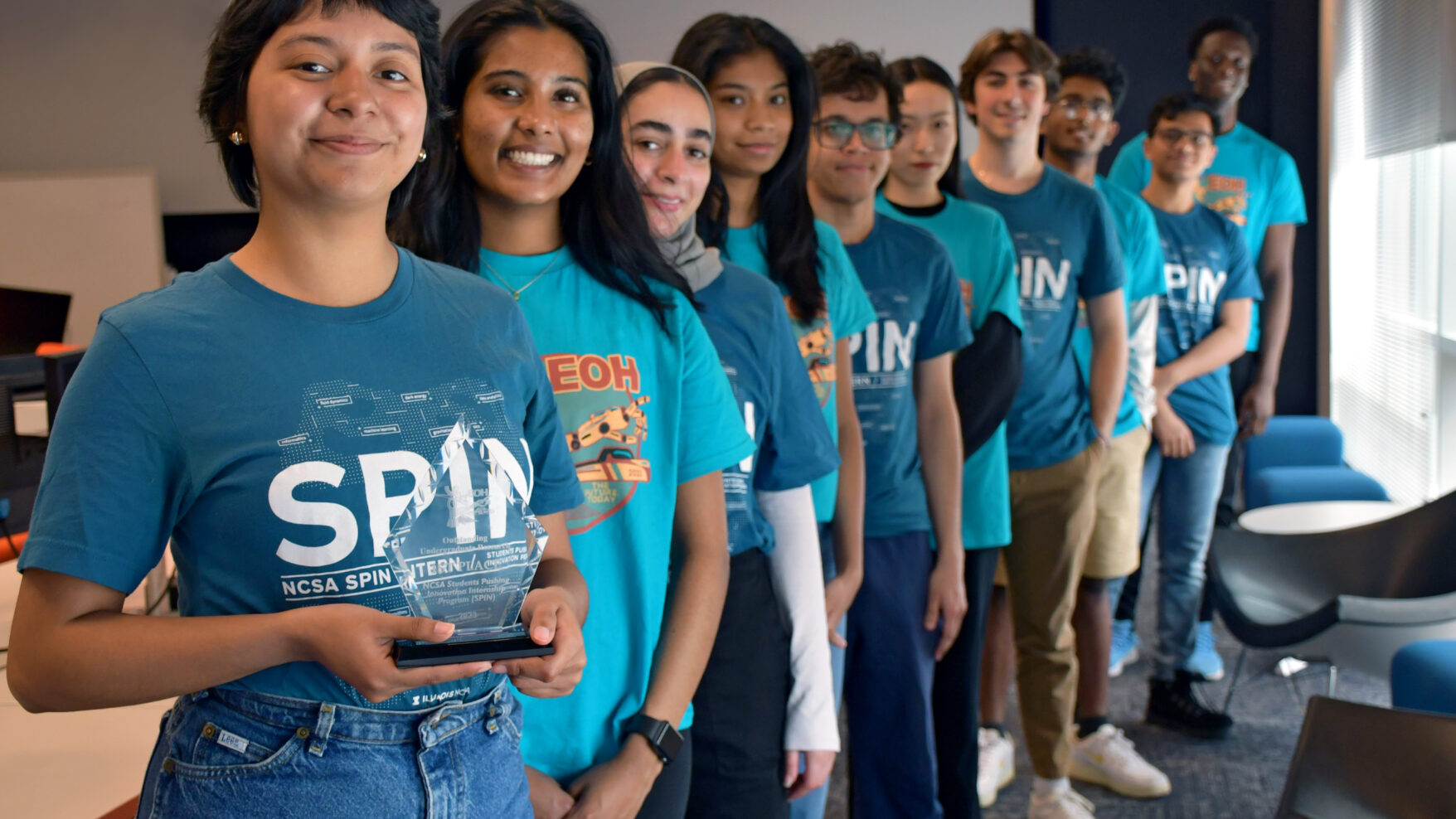
At NCSA, important research is being done every day. Everything from working towards better cancer treatments to studying supernovae is included in NCSA’s portfolio of research projects. But NCSA doesn’t stop there. The Center also wants to help train and inspire future researchers. Through our many undergraduate student research opportunities, NCSA offers hands-on time with ongoing research with experts in their fields.  The NCSA-funded Students Pushing Innovation (SPIN) and the National Science Foundation (NSF) -funded  Research Experiences for Undergraduate (REU) programs both provide a one-of-a-kind experience for students interested in careers in research. By embedding REU and SPIN students in the projects, the students learn how research is conducted while working toward a research goal.
/*! elementor – v3.17.0 – 25-10-2023 */
.elementor-widget-image{text-align:center}.elementor-widget-image a{display:inline-block}.elementor-widget-image a img[src$=”.svg”]{width:48px}.elementor-widget-image img{vertical-align:middle;display:inline-block}

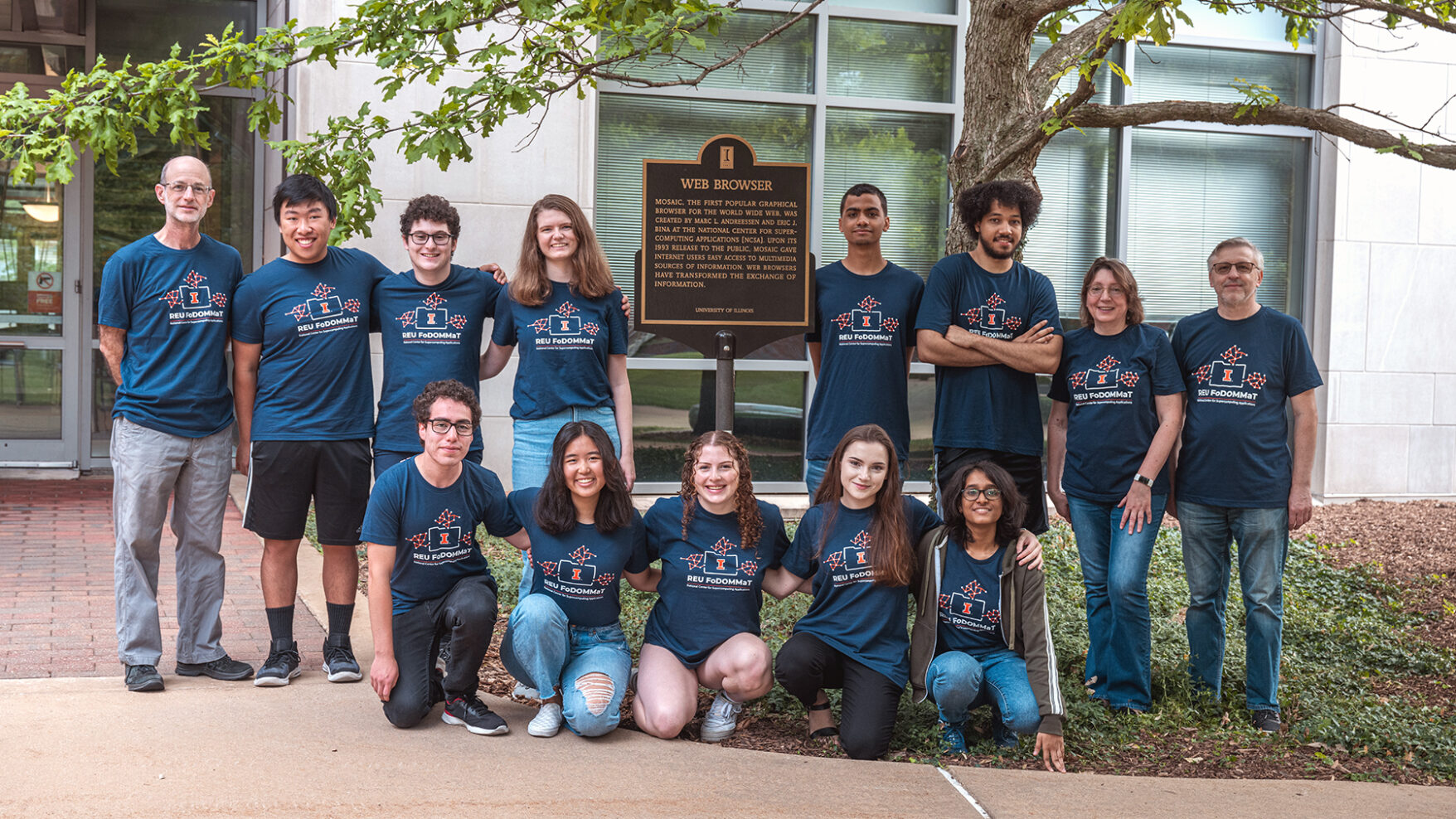
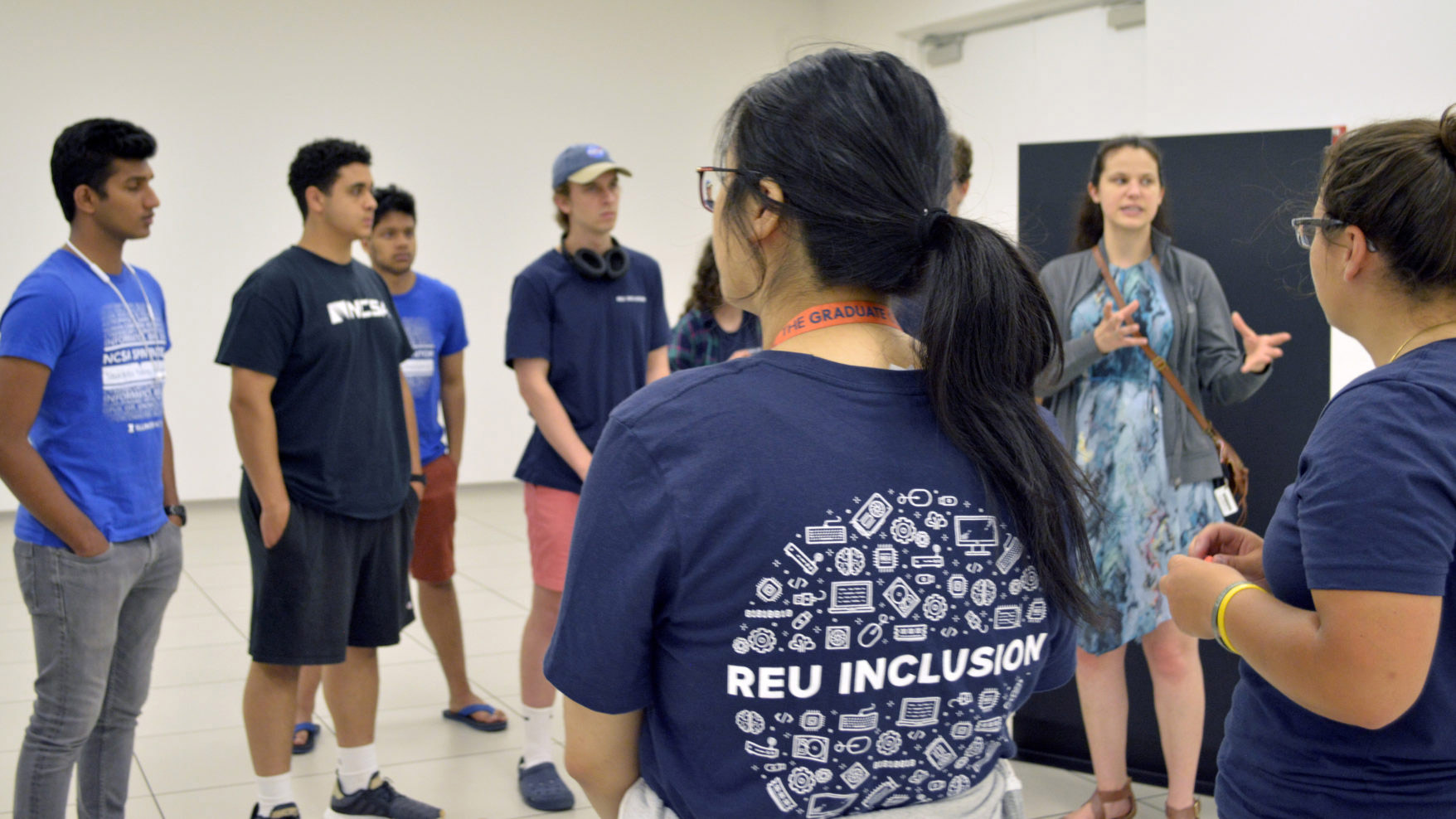
Being embedded on research teams isn’t the only opportunity available to SPIN and REU “The Future of Discovery: Training Students to Build and Apply Open-Source Machine Learning Models and Tools” (FoDoMMaT) students. NCSA interns and fellows are also encouraged to participate in professional development via conference attendance and participation. Students are supported by their mentors and the administrators of these programs, and funding for conference fees and materials is provided by NCSA. This year, students participated in the Grainger College of Engineering’s annual Engineering Open House, with SPIN students winning first place for their exhibit. SPIN and REU FoDoMMaT students also participated in the STEM Career Exploration and Symposium. As members of the Illinois Summer Research Programs Alliance (ISRPA), the students represented NCSA’s programs in a this summer’s event. The symposium had 120 student presenters across ISRPA and over 400 attendees. During the symposium, students engaged with 13 different industry partners and six professional organizations. They also reached out to 53 community college students and educators from across the state and helped them see the possibilities within the STEM field.

To understand how much value there is in these student opportunities at NCSA, it’s best to hear about these programs in the student’s own words. Here are just a few of the students and the projects they’ve worked on over the summer.

/*! elementor – v3.17.0 – 25-10-2023 */
.elementor-heading-title{padding:0;margin:0;line-height:1}.elementor-widget-heading .elementor-heading-title[class*=elementor-size-]>a{color:inherit;font-size:inherit;line-height:inherit}.elementor-widget-heading .elementor-heading-title.elementor-size-small{font-size:15px}.elementor-widget-heading .elementor-heading-title.elementor-size-medium{font-size:19px}.elementor-widget-heading .elementor-heading-title.elementor-size-large{font-size:29px}.elementor-widget-heading .elementor-heading-title.elementor-size-xl{font-size:39px}.elementor-widget-heading .elementor-heading-title.elementor-size-xxl{font-size:59px}

CHANCHARIK MITRA

Project: SPatial analysis of tumor heterogeneity using machine-Learning Techniques

Chancharik Mitra is a fellow in the FoDOMMaT REU program. The FoDOMMaT program, now in its third year, has been highly successful at matching students with interesting research.

Mitra comes to NCSA from the University of California, Berkeley. He was keen to get more experience to help with his career aspirations. “I have always been passionate about research,” he said, “especially in computational biology as well as vision and language deep-learning models. My current goal is to pursue a Ph.D. and conduct research in understanding and fighting disease, as well as exploring vision and language methods to provide agents with high-level, compositional reasoning abilities.”

Mitra has been an REU fellow before. He was so impressed with the FoDOMMaT program last summer he applied for a second year to continue working on the project he started. “This is my second summer as an REU fellow at NCSA, having continued my research as a visiting scholar throughout the academic year.” Mitra’s project involves examining tumors at a micro level. Being able to understand the makeup of a tumor fully can help with more effective treatment.

As Mitra explains it, “Broadly, my research involves analyzing spatial transcriptomics data using statistical and machine-learning methods to gather insight into cancer. Aspects of cancer-omics research that are especially interesting to me include understanding cancer tumor heterogeneity and the impact of treatment on the spatial transcriptome of cancer tissue. My current work specifically deals with finding informative genes (called biomarkers) that can help further research, analysis, and treatment development for cancers.”

Each member of the research team is given tasks to work on – the students are treated as fully integrated members of the team, working alongside their mentors to reach their goal and, eventually, having their names included in any publications based on their work. Mitra is no exception, already having lead authorship on a paper titled Spatial Analysis of Tumor Heterogeneity Using Machine Learning Techniques. Mitra also presented the paper at a conference, earning him further experience and recognition.

“My current goal is to develop an explainable pipeline for mining biomarkers related to cell and metabolic pathways significant for understanding cancer,” Mitra said. “Leveraging permutation importance feature extraction in combination with random forest classifiers and neural network methods, I am focusing on identifying biomarkers associated with the pathway of cell proliferation using liver-specific, metastatic ER+ breast tumors. I’m looking at not only finding relevant biomarkers but also extensively validating and explaining their importance as well, something quite novel in this space of work.”

Working on a project like this has helped illustrate how collaborative this type of research is. “As with most computational biology research, there is a lot of collaboration in our group!” Mitra said. “Put simply, the computational researchers in our group rely on the insight of biological researchers and vice-versa. I work closely with all members of the group who provide advice on interesting questions and directions to explore.”

Mitra has high praise for the program and says his application for a second year only proves how great an experience it’s been. 

/*! elementor-pro – v3.16.0 – 20-09-2023 */
@charset “UTF-8″;.entry-content blockquote.elementor-blockquote:not(.alignright):not(.alignleft),.entry-summary blockquote.elementor-blockquote{margin-right:0;margin-left:0}.elementor-widget-blockquote blockquote{margin:0;padding:0;outline:0;font-size:100%;vertical-align:baseline;background:transparent;quotes:none;border:0;font-style:normal;color:#3f444b}.elementor-widget-blockquote blockquote .e-q-footer:after,.elementor-widget-blockquote blockquote .e-q-footer:before,.elementor-widget-blockquote blockquote:after,.elementor-widget-blockquote blockquote:before,.elementor-widget-blockquote blockquote cite:after,.elementor-widget-blockquote blockquote cite:before{content:none}.elementor-blockquote{transition:.3s}.elementor-blockquote__author,.elementor-blockquote__content{margin-bottom:0;font-style:normal}.elementor-blockquote__author{font-weight:700}.elementor-blockquote .e-q-footer{margin-top:12px;display:flex;justify-content:space-between}.elementor-blockquote__tweet-button{display:flex;transition:.3s;color:#1da1f2;align-self:flex-end;line-height:1;position:relative;width:-moz-max-content;width:max-content}.elementor-blockquote__tweet-button:hover{color:#0967a0}.elementor-blockquote__tweet-button span{font-weight:600}.elementor-blockquote__tweet-button i,.elementor-blockquote__tweet-button span{vertical-align:middle}.elementor-blockquote__tweet-button i+span,.elementor-blockquote__tweet-button svg+span{margin-left:.5em}.elementor-blockquote__tweet-button svg{fill:#1da1f2;height:1em;width:1em}.elementor-blockquote__tweet-label{white-space:pre-wrap}.elementor-blockquote–button-skin-bubble .elementor-blockquote__tweet-button,.elementor-blockquote–button-skin-classic .elementor-blockquote__tweet-button{padding:.7em 1.2em;border-radius:100em;background-color:#1da1f2;color:#fff;font-size:15px}.elementor-blockquote–button-skin-bubble .elementor-blockquote__tweet-button:hover,.elementor-blockquote–button-skin-classic .elementor-blockquote__tweet-button:hover{background-color:#0967a0;color:#fff}.elementor-blockquote–button-skin-bubble .elementor-blockquote__tweet-button:hover:before,.elementor-blockquote–button-skin-classic .elementor-blockquote__tweet-button:hover:before{border-right-color:#0967a0}.elementor-blockquote–button-skin-bubble .elementor-blockquote__tweet-button svg,.elementor-blockquote–button-skin-classic .elementor-blockquote__tweet-button svg{fill:#fff;height:1em;width:1em}.elementor-blockquote–button-skin-bubble.elementor-blockquote–button-view-icon .elementor-blockquote__tweet-button,.elementor-blockquote–button-skin-classic.elementor-blockquote–button-view-icon .elementor-blockquote__tweet-button{padding:0;width:2em;height:2em}.elementor-blockquote–button-skin-bubble.elementor-blockquote–button-view-icon .elementor-blockquote__tweet-button i,.elementor-blockquote–button-skin-classic.elementor-blockquote–button-view-icon .elementor-blockquote__tweet-button i{position:absolute;left:50%;top:50%;transform:translate(-50%,-50%)}.elementor-blockquote–button-skin-bubble .elementor-blockquote__tweet-button:before{content:””;border:.5em solid transparent;border-right-color:#1da1f2;position:absolute;left:-.8em;top:50%;transform:translateY(-50%) scaleY(.65);transition:.3s}.elementor-blockquote–button-skin-bubble.elementor-blockquote–align-left .elementor-blockquote__tweet-button:before{right:auto;left:-.8em;border-right-color:#1da1f2;border-left-color:transparent}.elementor-blockquote–button-skin-bubble.elementor-blockquote–align-left .elementor-blockquote__tweet-button:hover:before{border-right-color:#0967a0}.elementor-blockquote–button-skin-bubble.elementor-blockquote–align-right .elementor-blockquote__tweet-button:before{left:auto;right:-.8em;border-right-color:transparent;border-left-color:#1da1f2}.elementor-blockquote–button-skin-bubble.elementor-blockquote–align-right .elementor-blockquote__tweet-button:hover:before{border-left-color:#0967a0}.elementor-blockquote–skin-boxed .elementor-blockquote{background-color:#f9fafa;padding:30px}.elementor-blockquote–skin-border .elementor-blockquote{border-color:#f9fafa;border-left:7px #f9fafa;border-style:solid;padding-left:20px}.elementor-blockquote–skin-quotation .elementor-blockquote:before{content:”“”;font-size:100px;color:#f9fafa;font-family:Times New Roman,Times,serif;font-weight:900;line-height:1;display:block;height:.6em}.elementor-blockquote–skin-quotation .elementor-blockquote__content{margin-top:15px}.elementor-blockquote–align-left .elementor-blockquote__content{text-align:left}.elementor-blockquote–align-left .elementor-blockquote .e-q-footer{flex-direction:row}.elementor-blockquote–align-right .elementor-blockquote__content{text-align:right}.elementor-blockquote–align-right .elementor-blockquote .e-q-footer{flex-direction:row-reverse}.elementor-blockquote–align-center .elementor-blockquote{text-align:center}.elementor-blockquote–align-center .elementor-blockquote .e-q-footer,.elementor-blockquote–align-center .elementor-blockquote__author{display:block}.elementor-blockquote–align-center .elementor-blockquote__tweet-button{margin-right:auto;margin-left:auto}

I can say with confidence that I have had a tremendously fruitful experience. The program is planned out meticulously by Mrs. Olena Kindratenko, with many opportunities to develop research skills as well as explore the eclectic variety of research being done at NCSA and UIUC more broadly. The mentorship I have received from my advisors, Dr. Aiman Soliman and Dr. Zeynep-Madak Erdogan, in research, presentations, and publications has been invaluable to me and has been an indelible part of my growth as a researcher.

Chancharik Mitra, REU fellow

Tweet

HEATHER BROOME

Project: An integrated sensing, machine learning and high performance computing framework for real-time decision-making in smart manufacturing

Heather Broome has had a busy year. Actively seeking research opportunities this summer, she jumped at the chance to be a part of the REU program at NCSA. She saw the potential to further her goals in the program. “I am passionate about building a future guided by ethically designed AI,” Broome said. “This path will likely be centered at the intersection of machine learning and robotics, a field that I had not been given an opportunity to experience before.”

Broome’s project could have a huge impact on next-generation manufacturing. “My project utilizes deep-learning models for end-to-end quality prediction in ultrasonic metal welding. The dataset used contains signals collected during the creation of each joint and its corresponding tensile strength. These tensile strengths were gathered using conventional quality prediction methods, which have a series of shortcomings that we hope to resolve using deep learning. The dataset was utilized by numerous pre-trained models capable of predicting the tensile strengths of new, unseen joints.”

Any manufacturing process that welds one piece of material to another could theoretically benefit from this research. If you think about all the things you use every day, much of it started as metal that needed to be welded. Chairs, cars, desks – you’ve probably used something in the last couple of hours that would have been welded at some point in the manufacturing process. “Modern joint quality prediction is destructive, expensive, time-consuming and less reliable than desired,” Broome said. “The goal of this project is to create a method for joint quality prediction that does not have such shortcomings while raising the bar for reliability.”

Broome made the most of her time within the program, speaking highly of the care in which NCSA’s REU program was designed and implemented. “The FoDOMMaT program provided me with an opportunity to learn valuable skills in both machine learning and in personal and professional development,” said Broome. “This program showed me the value of maintaining consistent effort even in the face of challenges, and it allowed me to prove my commitment to research in a way that was not possible before. Not only was I surrounded by students and mentors who shared my passion for machine learning, I was placed in the hub of cutting-edge research and leading experts. I took full advantage of the environment provided by this program and made numerous connections with outstanding researchers from a variety of fields. These relationships have significantly furthered my understanding of research, academia and professionalism, making a life-long impact on my education and career.”

The mentorship aspect of NCSA’s REU programs is just as important as matching students up with research they’re passionate about. Broome found that being a part of a team of experts was an essential part of the experience.

“I believe that Priyam Mazumdar’s contributions to this program should also be greatly noted. He was an incredible teacher and mentor for all students in the program, and I can say without a doubt that all of us were beyond grateful to have his guidance and encouragement.”

Wishing to maximize her experience while an REU fellow, Broome also explored any additional opportunities for research while she was working on her project. She discovered there were more opportunities that would gel well with her interests. “During my time at UIUC, I joined Dr. Nancy Amato’s Parasol Lab. Not only was I able to gain experience with robotics and machine learning simultaneously, but I was also able to work under the guidance of a leading innovator in the field of motion planning. The experiences and friendships I gained throughout this program are invaluable, and I cannot thank the NCSA enough for such an opportunity.”

I enjoyed being in an environment full of students who shared my passion for this field. Whenever I was challenged, I felt supported by other fellows and their commitment to pushing through similar moments of doubt or fatigue. Research is not an easy path, but the support and encouragement that surrounds FoDOMMaT fellows during their journey is irreplaceable.

Heather Broom, REU student

Tweet

ALEJANDRO DUQUE

Project: Workflow Tradeoffs in the context of cancer Phylogeny

Alejandro Duque is from the Universidad San Francisco de Quito. His department selected him to participate in research at NCSA this summer in the Center’s International Research Internship Program. He was excited to be involved in a project dealing with cutting-edge technology. 

“I’m researching ways to integrate modern software tools with scientific workflows,” Duque said. “Workflows are defined as computational steps applied to data to perform a certain task. I’m specifically working with Parsl, which is a Python library, and the OpenAI API. The first goal of the project is to evaluate Parsl in the field of scientific workflow definitions. The second goal is to explore ways to use AI to facilitate the use of scientific workflows.”

Duque makes no secret about what he feels is the best part of working on this research project. “The most interesting part of the project has been using the OpenAI API,” he said. “By now, everyone knows how powerful NLP models like ChatGPT are. Although their applications in software development are just emerging, I believe they could quickly revolutionize the way software is developed in the coming years.”

Like many of the REU students, Duque found the work to be challenging but rewarding. “My biggest takeaway [from the program] is that research is not linear. Sometimes you take the right path and come up with something useful. Other times you get stuck, but that’s never the end of the road. You have just discovered a way of not doing things, and that too is knowledge.”

Duque was pleased with his experience within the program, especially with how it has positioned him to take advantage of career opportunities within the research field. “This REU has given me the opportunity to have hands-on experience with state-of-the-art technology. Innovation within software development moves as fast as the tide; if you don’t go with the flow, you’ll be left behind. I think NCSA is a great place to navigate, even if your future plan, like mine, is to work in the industry as a software developer.”

In the end, it wasn’t just the knowledge and the mentorship Duque appreciated about his time in the program. His words show that these programs are more than just learning opportunities. They are a chance to meet like-minded individuals who share your passions and make new connections that you may carry with you for many years.

There’s something special about sharing a room with nine other like-minded people. It is true that everyone works on their own project, and most of the time, that is what we do in the computer lab. But every once in a while, someone says something that sparks a conversation, a plan for the weekend, or just a laugh. Those moments of serendipity are what stand out the most.

Alejandro Duque, REU student

Tweet

ANNA BASKIN, SARVAGNYA VIJAY, NISHK PATEL

Project: Machine learning and Geospatial approach to targeting humanitarian assistance among syrian refugees in lebanon

This unique collaboration was assigned students from two different student research groups, SPIN and REU FoDoMMaT. The team made up of two SPIN interns, Sarvagnya Vijay and Nishk Patel, and one REU FoDoMMaT fellow, Anna Baskin, synergized well. 

The project they worked on was designed to tackle a large problem that affects millions. In February of 2022, it had already been 11 years since the Syrian refugee crisis began. More than six million Syrians were forced to flee their country. That same number again still lived within Syria but were displaced from their homes. The initial crisis drew many humanitarian groups and donations, and funds from the UN were shared with people in dire need of cash. However, in the 11 years since that time, the keen interest that spurned on those cash flows had ebbed, requiring organizations like the United Nations High Commissioner for Refugees (UNHCR) to stretch their funding. Then in February of 2022, Russia invaded Ukraine again, attempting to forcibly take the entire country. With the Ukraine refugee crisis, 17.6 million more people required aid, straining an already strained resource.

This team’s project attempts to find ways to better distribute the limited resources available to aid agencies. It’s a large task with a lot of moving parts. This team had a very specific goal within the project.

“This project identifies potential geospatial features which influence where Syrian refugees choose to settle in Lebanon using machine-learning techniques,” Vijay said, speaking on behalf of the whole group. “We extract feature data from a variety of sources, preprocess it, and run several interpretable machine-learning algorithms to find the best predictor, then generate the relative feature importance of each geospatial feature in order to identify which features have the highest impact on refugee density. Determining which features influence the geospatial distribution of refugees would enable humanitarian organizations like the United Nations to predict changing refugee populations across Lebanon, allowing for more efficient and impactful aid allocation.”

With such a large project, collaboration is key to keeping everyone on the same page. “Our most effective method of sharing project tasks has been to have a recap meeting after our standup meeting with our mentors,” said Vijay. “This is where we organize our thoughts and make sure we’re on the same page before setting a weekly goal. After that, we further divide the weekly goal into subparts and evenly distribute the work among the three of us.”

Projects assigned to fellows and interns come from a wide range of disciplines. If you’re interested in expanding your experiences and preparing for a role as a researcher post graduating, you can find information about all of NCSA’s student opportunities here.

NCSA SUMMER PROGRAM RECOGNITIONS

REU FODOmMAT

SPIN

Anna Baskin
Heather Broome
Cassandra Goldberg
Tejal Kulkarni
Benjamin Lash
Jessica Liang
Chancharik Mitra
Michael Rivera
Abdullah Syed
Scott Zhao

Bach Hoang
Atharva Jain
Yichen Liu
Nishk Patel
Linh Pham
Jakub Sowa
Ashley Turner
Sarvagnya Vijay

NCSA International Research Internship Program

Alejandro Javier Duque Aguilera, USFQ, Ecuador

Visiting Scholar

Kiet Pham, NRT, Physics Ph.D. student at the University of Minnesota

Outstanding Summer Mentors

Bruno Abreu
Mohamad  Alipour
Roland Haas
Matthew Krafczyk
Santiago Nunez-Corrales
Aiman Soliman
Yifang Zhang

Engineering Open House at NCSA

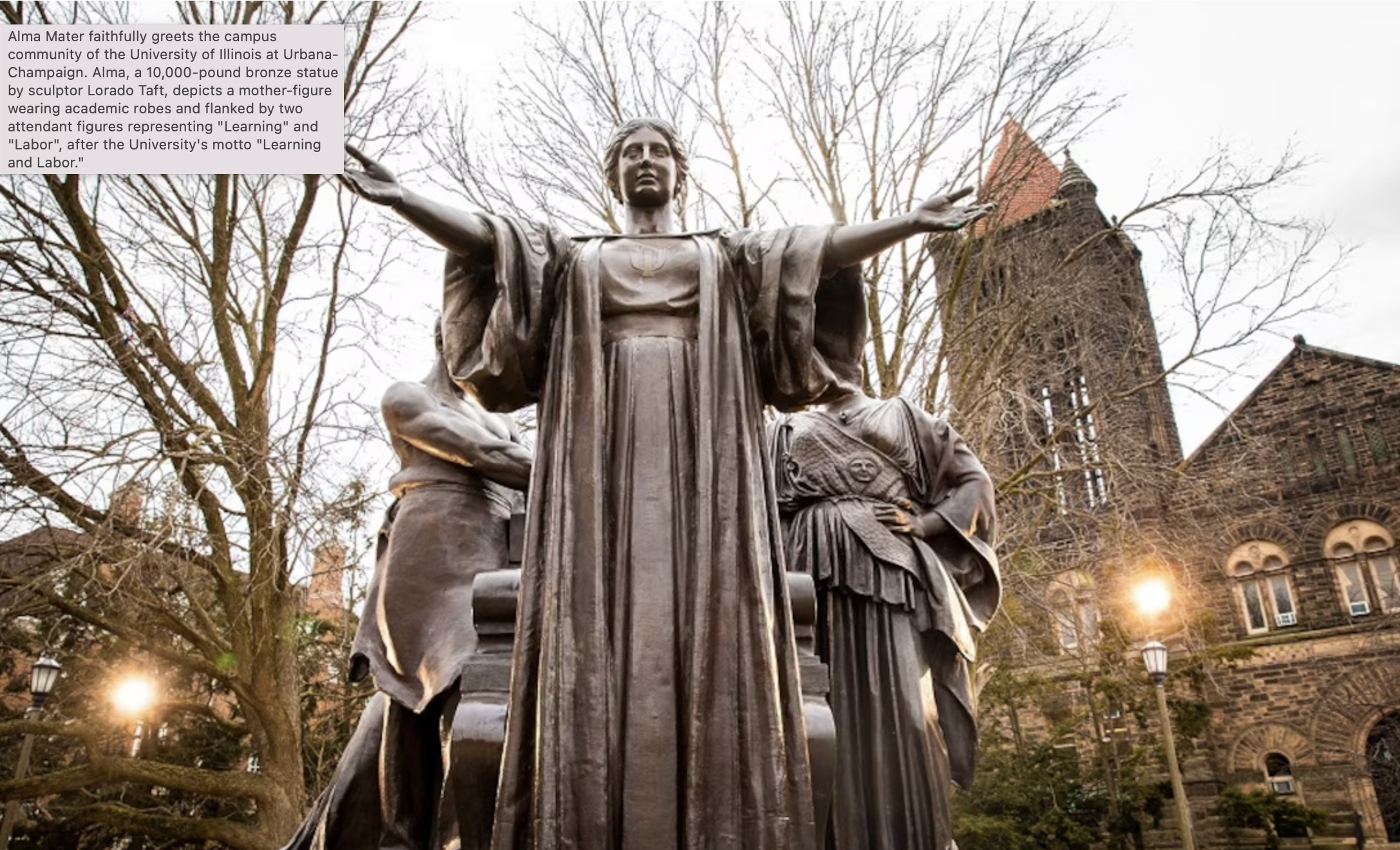
NCSA has proudly been a part of Engineering Open House (EOH), an event organized by the Grainger College of Engineering, for many years, hosting exhibits in the NCSA building each spring. This year, NCSA got right back into the swing of things and hosted a number of exhibits from a variety of projects supported by the Center. NCSA deftly showcased the breadth and depth of our work and support with researchers in everything from artificial intelligence to genomics. One of NCSA’s own even took home first prize for their outstanding research.
An Award-Winning Showcase

NCSA exhibits have had a strong impact on judges each year at EOH. In  2021, NCSA swept the EOH awards. NCSA’s Students Pushing Innovation Internship Program (SPIN) won third place that year. This year, SPIN improved on its past success and took home the top prize wowing judges with their exhibit highlighting the various projects students worked on over the last year. 

SPIN students are paid interns paired with experts at NCSA doing high-level research. It’s a wonderful opportunity for undergraduates to get hands-on experience doing research in their fields. Projects vary widely and include topics like Natural Language Processing (NLP), black hole research and Optical Character Recognition (OCR).

See full article here

CAII Undergraduates Graduate December 2022

December was the time for holidays, food, snow and and although many don’t usually think of it – Graduation!


We would like to offer congratulations to two CAII undergrads who wrote their senior theses with Volodymyr Kindratenko, Director of NCSA Center for Artificial Intelligence Innovation,  as their advisor.  Their achievements are made even more remarkable by the challenges faced over the past couple of years. Here are some highlights about them:

 

Joseph Rejive, Fall 2022 Graduate

Bachelor of Science – Electrical and Electronics Engineering

ML and Speech Recognition Intern at NCSA

Senior Thesis:  Implementing Sparse CNNs on FPGAs

Plans After Graduation:


I’ll be working full time as a GPU Architect Engineer at Nvidia. After a few years, I plan on pursuing my Master’s degree in Electrical Engineering, before returning to work in industry. 


What has been your biggest achievement at University of Illinois: 

My biggest achievement at UIUC is being able to financially support my three and a half years of study by participating in paid research positions, including the NCSA SPIN internship. 


What is your favorite memory at NCSA:

My favorite memory at NCSA was being able to meet a variety of people during the ice-cream social during my first year as a SPIN intern!


William Eustis, Fall 2022 Graduate

Bachelor of Science – Computer Engineering

Deep Learning Intern at NCSA

Senior Thesis: Exploring Sparse and Novel Computer Vision Architectures

Plans After Graduation:


I’m starting as a Hardware Engineering at Jump Trading in Chicago later in 2023. I’ll be doing FPGA design for low latency networking. 


What has been your biggest achievement at University of Illinois:

I was the course lead for several of the introductory ECE and CS honors courses (ECE 110 Honors, ECE 120 Honors, CS196, CS 124 Honors, CS 128 Honors, and ECE 210 Honors). I’ve had the amazing opportunity to design courses to support the supervised personal projects, special topic instruction, and general education of over just 1000 students across two years. The courses now have new leads, but I’m proud of the students I taught during my time as lead and the amazing communities that exist after my departure. 


What is your favorite memory at NCSA:

Professor Kindratenko’s mentorship has been a never-ending source of support. I’m extremely thankful to him as well as the entire NCSA community for organizing and allowing me to participate in such a wonderful opportunity. I can’t quite pin down a single favorite memory but my mentor, fellow students, and other researchers and staff at NCSA has made my experience one to cherish.

NCSA Student Researchers Lead Authors on Award-Winning Paper

Student researchers from the National Center for Supercomputing Applications and the University of Illinois Urbana-Champaign were lead authors on a paper titled, “FAIR principles for AI models with a practical application for accelerated high energy diffraction microscopy,” which earned an HPCwire Readers’ Choice award that was formally announced at SC22 on Nov. 14.

Nikil Ravi and Pranshu Chaturvedi, along with scientists from the Argonne National Laboratory and the University of Chicago, introduced a novel set of practical, concise, and measurable FAIR (Findable, Accessible, Interoperable, Reusable) principles for AI models. They showcased their approach with a domain-agnostic computational framework that brings together the Advanced Photon Source at Argonne, the Materials Data Facility, the Data and Learning Hub for Science, funcX, Globus, the ThetaGPU supercomputer, and the SambaNova DataScale system at the Argonne Leadership Computing Facility. 

Researchers combined Nvidia A100 GPUs, Nvidia TensorRT, Docker, Apptainer (formerly Singularity), and the SambaNova DataScale system to demonstrate the use of AI surrogates to enable accelerated and FAIR AI-driven discovery for high-energy diffraction microscopy. The work presents a domain-agnostic computational framework to enable autonomous AI-driven discovery at scale and is showcased in the context of accelerated high-energy diffraction microscopy.

Ravi also received a Fiddler Undergraduate Innovation Fellowship award and Outstanding Oral Presentation Award at the Undergraduate Research Symposium at UIUC for this research. Both Ravi and Chaturvedi participated in NCSA’s Students Pushing Innovation (SPIN) program.

“I started working with my mentor, Dr. Eliu Huerta, through NCSA’s SPIN program,” Ravi said. “The SPIN internship program helped connect me with many like-minded peers and provided a lot of resources and support. It was also through the SPIN internship that I learnt how to use HPC systems and that knowledge really helped me with my research.”

It’s an honor to receive the HPCwire award for our work. The project was highly collaborative and we put a lot of effort into it. It is wonderful to see it get recognized on a global scale.

Read more about the paper here.

Students Pushing Innovation (SPIN)
1205 W. Clark St.
Urbana, IL 61801
Email: kindrat2@illinois.edu
CookieSettings CookieSettings